
executive briefings
Executive Briefing / July 2026
Optimizing Service Level Metrics: Structuring Defensible SLA Frameworks to Prevent Performance Dilution in Technology Transactions
Executive Overview
In enterprise technology transactions, particularly long-term managed services, cloud infrastructure hosting, or critical software-as-a-service (SaaS) deployments, the design of Service Level Agreements (SLAs) is a critical lever for operational risk management. Standard vendor templates routinely employ flawed metrics, broad measurement windows, and convoluted exclusion clauses that systematically mask operational underperformance.
Accepting these vendor-favourable parameters exposes an enterprise to persistent service degradation without meaningful financial or legal recourse. Protecting the enterprise requires establishing precise, mathematically sound performance definitions, forcing the vendor to accept comprehensive measurement windows, and implementing automated, escalating remedy structures that compel operational compliance rather than passive financial write-offs.
Critical Risk Vector: The "Averaging" Loophole and Tactical Service Dilution
A primary vulnerability in standard vendor SLAs is the use of macro-level averaging, where short-term, catastrophic performance failures are obscured by high aggregate metrics calculated over extended periods.
The Exposure: Standard vendor terms frequently define availability or response times on a monthly or quarterly aggregate basis. For example, a 99.9% monthly uptime target sounds robust but permits over 43 minutes of unannounced downtime per month. If this downtime occurs during peak transactional hours, the financial damage to the enterprise is severe, yet the vendor remains contractually compliant. Underperforming vendors exploit this by concentrating maintenance windows or allowing system degradation during critical business hours, knowing that off-peak performance will lift the mathematical average back into compliance zones.
Strategic Mitigation: Contractual Guardrails for Rigorous SLA Governance
To neutralise these structural pitfalls, enterprise procurement and legal teams must embed three core pillars into the contracting framework:
Granular Measurement Windows and Concatenation Limits
Replace quarterly or monthly averaging with weekly or daily measurement intervals for high-severity systems.
Introduce "consecutive minutes" or "maximum single-incident duration" caps. For instance, any single outage exceeding 15 minutes during core business hours must automatically trigger a critical service level default, irrespective of the broader monthly average.
Elimination of Overbroad Exclusion Clauses
Vigorously negotiate vendor-drafted exclusions such as "scheduled maintenance" or "force majeure events" that act as blank cheques for unpunished downtime.
Require all scheduled maintenance to occur strictly within pre-approved, non-business hour windows, with mandatory 14-day advance notice.
Cap total permitted maintenance hours per month; any exceedance must count directly against availability metrics.
Earned Remedies and Escalating Service Credits
Ensure service credits are meaningful, liquidated damages rather than nominal tokens. Credits should scale quadratically, not linearly, with the severity and duration of the breach.
Construct a chronic non-performance clause. If the vendor misses any critical service level target three times within a rolling six-month period, the enterprise must gain the right to terminate the agreement for cause without penalty, alongside the immediate repayment of unearned implementation fees.
Conclusion
Failing to secure rigorous, defensible Service Level Agreements at the outset of a technology transaction locks the enterprise into a structural disadvantage. When metrics are diluted by macroaveraging and buffered by expansive exclusions, the contract ceases to function as a mechanism for quality assurance, transforming instead into a shield for vendor underperformance.
Mitigating this risk requires moving beyond nominal uptime percentages to enforce granular measurement, strict maintenance boundaries, and escalating financial penalties. By establishing clear contractual consequences for operational failure, enterprise technology leaders can shift the financial burden of downtime back onto the provider, ensuring that service levels remain aligned with core business requirements throughout the lifecycle of the agreement.
Executive Briefing / April 2026
Managing Scope Creep and Unbundled Fees: Structuring "New Services" Protocols to Prevent Exploitative Change Orders in Technology Transactions
Executive Overview
In enterprise technology transactions, particularly long-term managed services, complex software integrations, or outsourcing arrangements, the boundary between in-scope services and "new services" is a frequent source of commercial friction. Standard vendor templates routinely utilize narrow definitions of contractually included activities, allowing providers to treat routine operational evolution or unexpressed technical dependencies as out-of-scope tasks.
Accepting these restrictive parameters exposes an enterprise to persistent cost escalation through excessive change orders for tasks that should be considered part of the core delivery stack. Protecting the enterprise requires establishing a precise, rigorous definition of what constitutes a genuine "New Service," forcing the vendor to maintain service continuity during scope disputes, and implementing structured guardrails around the estimation and pricing of expanded requirements.
Critical Risk Vector: The Unbundled Fee Loophole and Tactical Stagnation
A primary vulnerability in loose scope definitions is the "nickel-and-diming loophole," where a vendor intentionally bids a low baseline fee and subsequently inflates profitability by charging extra for standard, auxiliary tasks.
The Exposure: Standard vendor terms frequently state that any service or feature not explicitly detailed in the contract text constitutes an out-of-scope item subject to independent, premium pricing. If an enterprise requires a minor software modification to maintain regulatory compliance, or if an unexpected data-mapping step arises during implementation, underperforming vendors may pause performance until an expensive change order is executed.
The Transactional Impact: Sourcing teams face unbudgeted cost overruns and protracted project delays, as the vendor leverages operational dependencies to compel the customer into signing high-margin amendment fees.
Structural Stability Vector: The Tripartite Test for New Services
To insulate the enterprise from unwarranted fee inflation, corporate negotiating teams should consider pushing for a narrow, three-part legal test that must be fully satisfied before any technical requirement can be formally classified as a New Service.
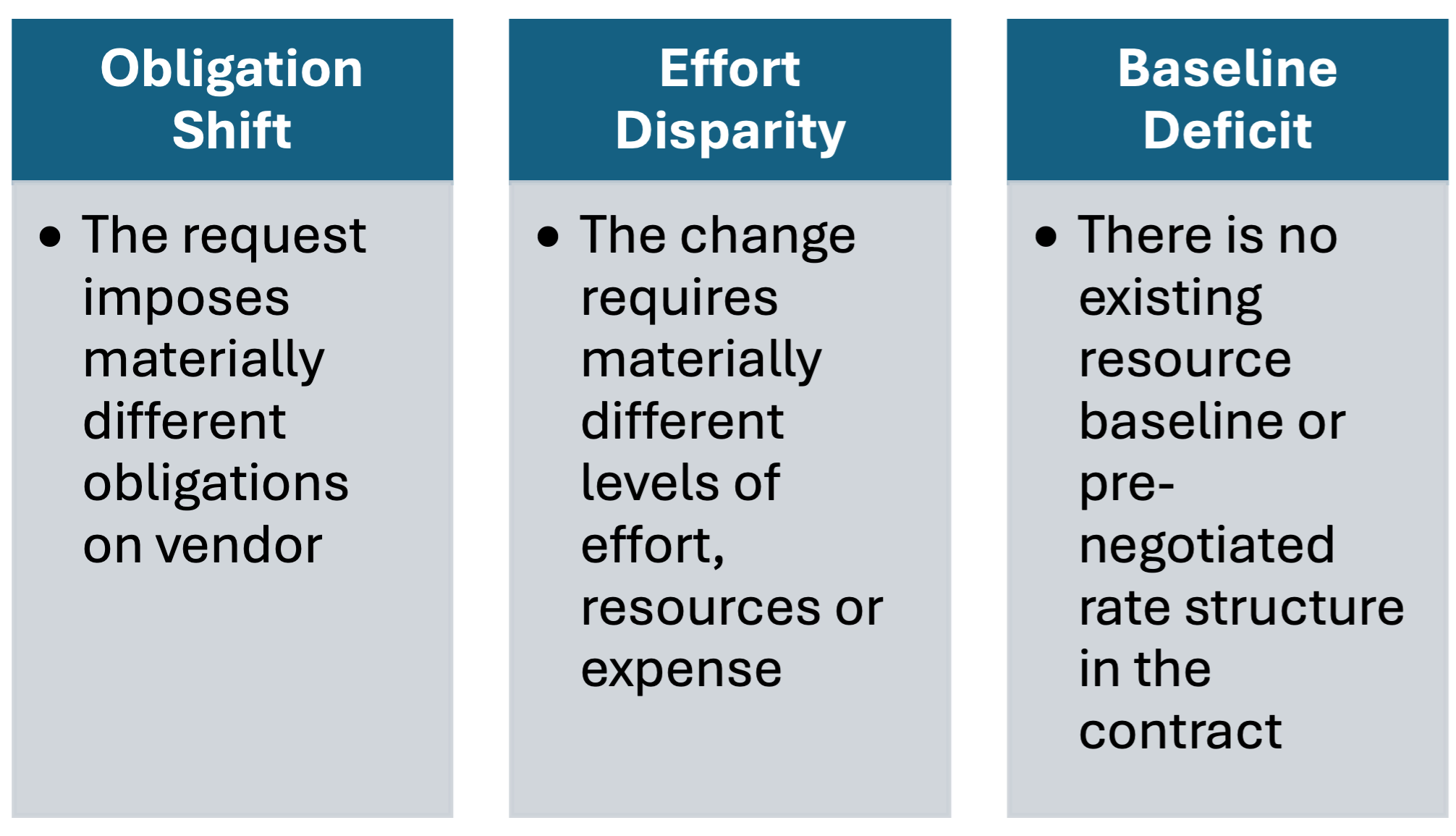
The Tripartite Criteria
Customers should endeavor to specify that a task or a significant modification to an existing service only qualifies as a New Service if it meets all three of the following conditions:
1. Materially Different Obligations: The request must impose entirely distinct functional or operational responsibilities on the vendor that are completely divorced from the intent of the original statement of work.
2. Materially Different Resource Levels: The execution of the task must demand a fundamentally higher level of effort, headcount, or technical expenditure from the vendor that could not have been anticipated during initial deal scoping.
3. Deficit of Charging Methodology: There must be an absolute absence of a relevant resource baseline, rate card, or charging methodology within the existing contract to evaluate or calculate the cost of the requested activity. If an existing rate card covers the required technical skill set, the work should be integrated under current pricing parameters rather than treated as a separate commercial event.
Structural Mechanics: Vendor Performance Mandates and Proposal Guardrails
Establishing an ironclad definition is insufficient if a vendor can refuse to provide the expanded services or hold operations hostage during a pricing disagreement. Sourcing teams should consider anchoring the scope change workflow around specific behavioral and operational guardrails.
The Mandatory Provision Obligation
The contract should explicitly state that the vendor is obligated to provide New Services upon written request from the customer, provided the requirements fall within the vendor's general technical capabilities. To ensure commercial transparency, the vendor must be required to submit a comprehensive proposal within a set timeframe (e.g., 10 business days). This proposal must detail the additional resource allocations, alternative architectures, and a transparent pricing breakdown that aligns with the closest comparable rate cards in the agreement.
The "Perform-While-Disputing" Covenant
To prevent project stagnation, it is recommended that the contract include a strict perform-while-disputing clause. If the parties disagree on whether a particular request constitutes an inherent part of the existing services or a valid New Service, the customer's project manager should have the right to issue a temporary directive. Sourcing teams should consider pushing for language specifying that:
The parties will immediately meet to discuss the scope and pricing in good faith.
The vendor must continue performing the disputed service without delay while those discussions are ongoing.
If the parties cannot reach an amicable agreement within a defined window (e.g., 15 business days), the service will continue uninterrupted, and the matter will be escalated to the formal dispute resolution and expedited arbitration processes established in the master contract.
Conclusion
Structuring a rigorous definition and operational workflow for New Services is a vital control for preserving the commercial integrity of long-term technology contracts. By forcing vendors to pass a strict tripartite test before charging additional fees, sourcing teams can successfully eliminate exploitative change orders for tasks that naturally belong within the core scope of work. Furthermore, tying this definition to a mandatory performance obligation and a perform-while-disputing mechanism ensures that the enterprise maintains operational momentum, prevents tactical project freezes, and routes pricing disagreements through a balanced, non-disruptive escalation pipeline.
Contact Our Team
This briefing is provided by Palantir Advisors, a global business and legal consulting practice. If you have questions about this briefing, or if you would like to discuss how these issues may impact your business operations, please reach out to us here.