
executive briefings
Executive Briefing / January 2026
The Enterprise AI Procurement Roadmap: Key Legal Risks and Risk Mitigation Strategies Across Major Software Spend Categories
Executive Overview
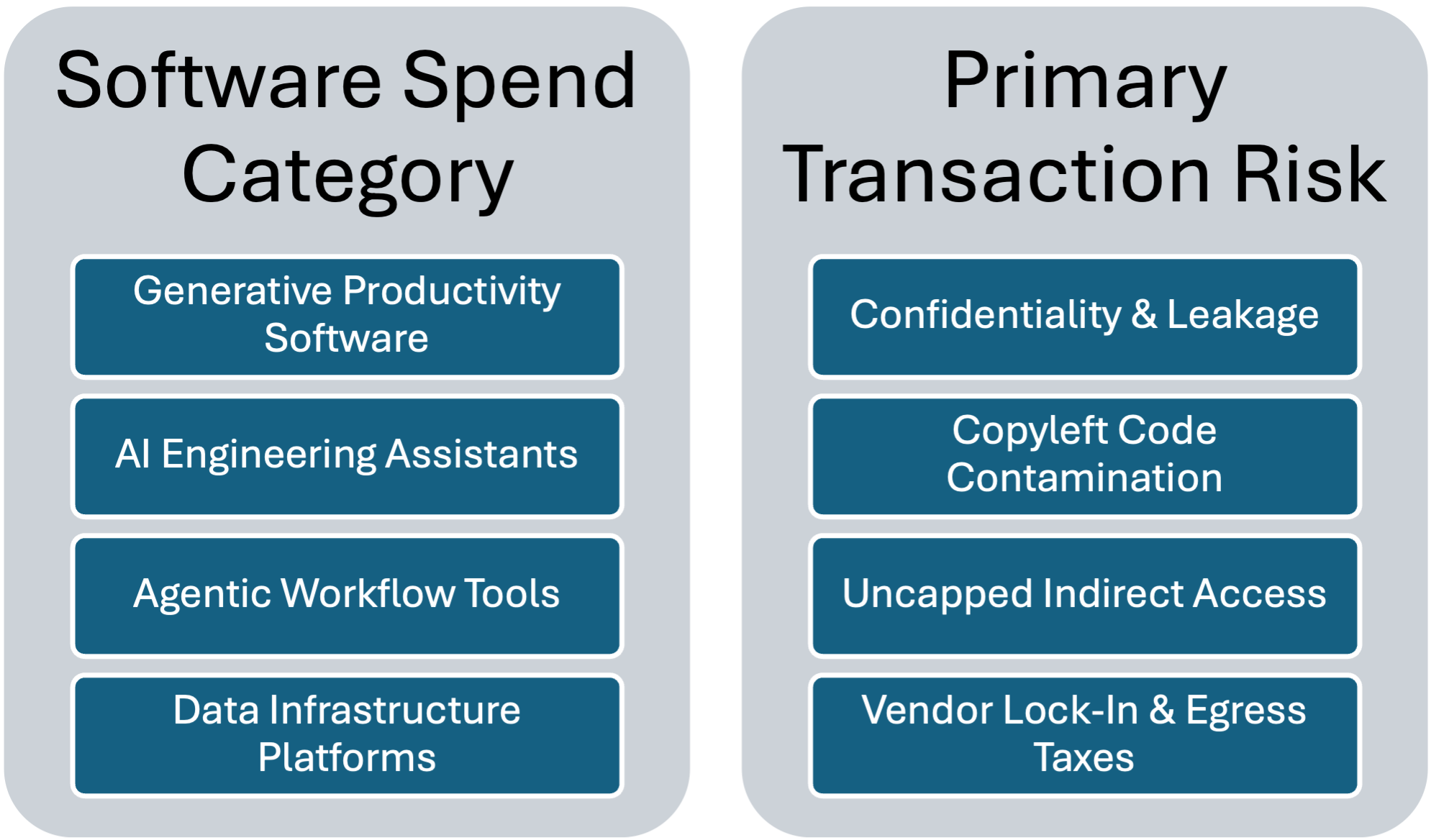
Global enterprise spending on artificial intelligence software has undergone a major shift. Corporate buyers have moved past theoretical testing and are committing multi-million-dollar budgets to tactical software that drives immediate, measurable efficiency. Software tracking data confirms that corporate technology budgets are heavily dominated by four distinct categories:
Generative Productivity Systems
AI Engineering Assistants
Multi-Step Agentic Workflow Tools
Enterprise Data Infrastructure Platforms.
However, deploying these advanced technologies under standard vendor-favorable software agreements introduces significant legal and operational exposure. To protect corporate technology budgets and shield proprietary digital assets, sourcing teams and corporate counsel must move beyond generic software procurement templates.
This article provides an objective breakdown of the critical legal risks and actionable risk-mitigation strategies for each dominant AI spend category.
1. Generative Productivity Software (Conversational Chat & Text Tools) Spend Profile: Mass employee expensing and enterprise-wide licensing of conversational text tools, content optimization platforms, and corporate summarization suites.
Key Legal Risks
Trade Secret and Data Leakage: Employees frequently paste proprietary software code, internal financial forecasting spreadsheets, and sensitive consumer metrics into unvetted public software prompts to speed up their daily tasks. Because standard consumer-facing applications utilize inbound user prompt histories to train public models, a company faces immediate asset erosion and breaches of client non-disclosure agreements (NDAs) if trade secrets are exposed to external users or market competitors.
Statutory Privacy Violations: Routing customer-identifying data into external cloud tools without explicit user authorization or structured data-deletion mechanisms directly breaches international privacy frameworks and data minimization rules.
Strategic Risk-Mitigation Controls
Enforce Non-Training Covenants: Restructure master subscription agreements to include explicit, non-negotiable clauses stating that the software provider possesses zero rights to harvest your queries, file uploads, or metadata to train public or vendor-owned models.
Deploy Endpoint Installation Gating: Configure enterprise mobile device management (MDM) platforms and network firewalls to automatically block employee access to unauthorized public consumer chatbots. Ensure all staff use secure, private corporate accounts.
2. AI Engineering Assistants (Code Agents & Automated Development) Spend Profile: Procurement of integrated code generation modules, automated application testers, and advanced software creation interfaces designed to accelerate software build cycles.
Key Legal Risks
Viral Copyleft Contamination: Automated code assistants train on vast open-source repositories and frequently reproduce copyrighted code fragments or public snippets without proper attribution. If an unchecked tool inserts a viral Copyleft license component (such as standard GPL code) into a company's proprietary software engine, the enterprise can be contractually forced to open-source its entire private codebase, completely destroying its underlying asset valuation.
Loss of Software Patent Protections: The integration of unvetted AI-generated scripts into commercial products can undermine an enterprise's ability to secure exclusive patent rights, as current legal frameworks restrict primary ownership to human-created code.
Strategic Risk-Mitigation Controls
Mandate Real-Time Code Filtering: Configure all incoming vendor development tools to run at maximum code-matching filtration levels, dynamically blocking the system from outputting any public or copyrighted code sequences.
Structure "Clean-Room" Warranties: Revise technology transaction templates to force software providers to explicitly represent, warrant, and indemnify your business against any open-source licensing conflicts running within their tools.
3. Multi-Step Agentic Workflow Tools (Back-Office Administrative Automation) Spend Profile: High-value subscriptions for specialized software agents built to read complex documentation arrays, extract contractual terms, process medical diagnostics, and handle automated client service routing.
Key Legal Risks
Uncapped Indirect Access Overages: Advanced automated agents utilize continuous background loops and API connections to query core enterprise databases. If your software contracts contain ambiguous or legacy user seat definitions, vendors can conduct retroactive compliance audits and claim that every automated software script querying the system counts as a separate human user seat, resulting in sudden, seven-figure retro-billing penalties.
Unmonitored Background Web Scraping: External automation tools often utilize background loops to capture bulk market metrics, which can easily violate platform digital terms of use and trigger anti-trust "hub-and-spoke" conspiracy claims if pricing is artificially stabilized with competitors.
Strategic Risk-Mitigation Controls
Redefine the Contractual "User" Perimeter: Ensure master contracts explicitly separate human user seats from automated, algorithmic, or API-driven connection pathways, bundling automated calls into baseline infrastructure fees.
Insert Dynamic Usage Grace Windows: Build flexible overage provisions into SaaS agreements that allow subscription seat allocations to adjust dynamically based on monthly usage spikes, protecting your procurement budgets from immediate vendor penalties.
4. Enterprise Data Infrastructure Platforms (Database Storage & Security Engines) Spend Profile: Funding of advanced machine learning platforms, secure multi-tenant data warehouses, and data lineage tracking engines built to structure raw internal architectures.
Key Legal Risks
Hyperscaler Dependency & Data Egress Taxes: Storing massive data volumes within a single provider’s network creates intense operational vendor lock-in. If an enterprise chooses to migrate its applications to a competing cloud infrastructure, vendors frequently impose steep outbound data egress charges and proprietary format restrictions to penalize migration.
Multi-Tenant Logical Separation Failures: Running data infrastructure within shared public cloud nodes creates vulnerabilities if the provider's database partition scripts contain flaws, increasing the risk of cross-client data contamination and leakage.
Strategic Risk-Mitigation Controls
Eradicate Data Exit Fees: Negotiate master infrastructure agreements to completely remove data exit taxes and financial penalties during migration windows, ensuring long-term multi-cloud portability.
Enforce Isolated Server Key Ownership: Restructure virtualized database layouts to ensure multi-tenant partitions maintain absolute cryptographic isolation, keeping your encryption keys under strict internal corporate control on shared servers.
Contact Our Team
This briefing is provided by Palantir Advisors, a global business and legal consulting practice. If you have questions about this briefing, or if you would like to discuss how these issues may impact your business operations, please reach out to us here.