
executive briefings
Executive Briefing / July 2025
Enterprise Platform Implementations: Managing Sourcing Pitfalls, Hidden Licensing Fees, and Operational Continuity in Major Systems Overhauls
Executive Overview
Undertaking a major overhaul of your company's core business platform—the central system that handles your accounting, human resources, supply chain, and customer data—is one of the largest capital investments your organization will make. As businesses execute these massive transformations to clean and organize their internal records before adopting advanced data analytics tools, these projects move far beyond routine software installations. They are high-stakes commercial agreements with long-term impacts on your operational budget.
Standard software contracts provided by major platform vendors are heavily weighted in favor of the sellers. If signed without amendments, they create severe financial and operational traps—ranging from catastrophic launch delays to millions of pounds in unexpected, retroactive user-license fees. This briefing analyzes the critical commercial risks hidden in major system implementations and outlines the practical contractual protections required to control vendor behavior and insulate your budget.
Critical Risk Vector: The "Indirect Access" Over-Billing Trap
One of the most severe vulnerabilities in modern enterprise software licensing is a concept known as Indirect Access.
The Exposure: Traditional software contracts calculate your fees based on direct human use—meaning the number of individual employees who physically log into a computer screen using company credentials. However, modern automated offices rely on automated bots, third-party software tools, and customer-facing websites that continuously query or push data into your central system behind the scenes via digital connectors (APIs).
The Transactional Impact: If your contract contains vague or outdated definitions of what a "user" is, software vendors can use their contract audit rights to claim that every automated system, bot, or device connecting to the central platform requires a full, standalone human user license. This tactical contract interpretation allows vendors to trigger retroactive compliance reviews, resulting in sudden, seven-figure back-billing penalties and unbudgeted software procurement deficits.
The Contractual Remedy: Sourcing teams must explicitly hard-code precise boundary limits into the contract's definition of authorized users. Master agreements must state that automated database pings, digital connections, and background data exchanges are bundled into your base infrastructure fees and do not count as separate, billable human users.
Structural Stability Vector: Project Delays & One-Sided Warranties
Because a major platform overhaul completely restructures your back-office operations, a failure or extended delay during the data-migration phase poses a direct threat to your revenue and day-to-day business continuity.
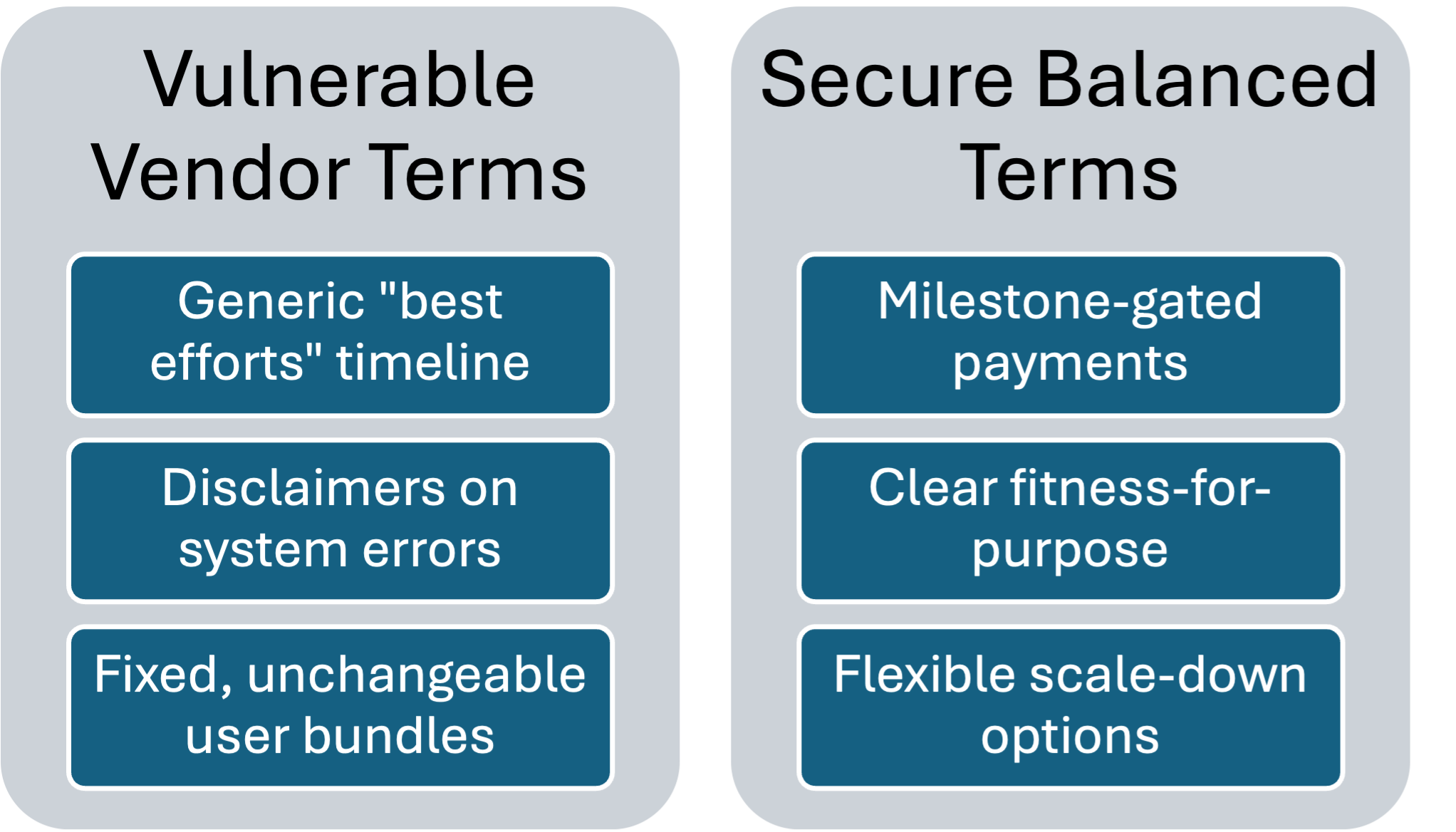
Software providers routinely attempt to deliver system implementations under generic "best efforts" timelines, utilizing broad liability waivers to insulate themselves from launch bugs, system errors, and data-mapping mistakes.
Transactional lawyers must reject these one-sided disclaimers. The contract must contain strict, milestone-gated warranties ensuring that the integrated platform is fit for its specific intended business purpose. Furthermore, the agreement must include comprehensive Disengagement Assistance Covenants, compelling the vendor to provide continuous system support and clear documentation if your enterprise decides to remove specific software modules or switch components later in the product lifecycle.
Strategic Action Items for Corporate Sourcing Teams
Redefine the "User" Perimeter: Revise master software definitions to explicitly separate individual human user seats from automated, background digital connections.
Enforce Milestone-Gated Payments: Link your system deployment schedule and data-migration phases directly to automatic billing credits, ensuring your business receives immediate financial remedies if a vendor misses key operational deadlines.
Secure Flexible User-Seat Scaling: Avoid rigid, multi-year flat-rate user packages. Embed flexible usage rules that let your subscription levels fluctuate dynamically based on your actual monthly user counts.
Deconstruct Platform Bundles: Structure procurement templates to unbundle complex application suites, granting your team the explicit right to scale down underutilized or unused "shelfware" seats without triggering total system price escalations.
Contact Our Team
This briefing is provided by Palantir Advisors, a global business and legal consulting practice. If you have questions about this briefing, or if you would like to discuss how these issues may impact your business operations, please reach out to us here.