
executive briefings
Executive Briefing / January 2025
Who Owns the Code? Protecting Your Intellectual Property and Data in Corporate Partnerships and Joint Ventures
Executive Overview
When two companies enter a strategic alliance, corporate partnership, or joint venture to co-develop a new technology, share operational data, or build a joint digital solution, the commercial excitement often overshadows a critical legal reality. Corporate partners routinely share their most valuable proprietary software code, customer data pools, and technical blueprints in shared digital workspaces without establishing clear legal ownership boundaries beforehand.
Failing to precisely structure intellectual property (IP) and data rights at the inception of a corporate partnership can lead to catastrophic results. A company risks losing exclusive rights to its pre-existing core technology, inadvertently giving away its trade secrets to a potential future competitor, or finding itself locked in a costly commercial stalemate if the partnership dissolves. This briefing analyzes the critical traps hidden in collaborative development and outlines practical, contractual strategies to protect your company's proprietary technology assets before any data or code changes hands.
Critical Risk Vector: The "Project Ingestion" Trap and IP Contamination
One of the most common and expensive legal blind spots in a technology collaboration is assuming that the line between what you owned before the project and what you create during the project will remain legally clear.
The Exposure: In modern software development, engineers from both firms often work within the same shared code repository or cloud server. If your contract relies on vague boilerplate phrases like "joint ownership of all project outputs," your partner's development team can weave your pre-existing proprietary source code or underlying architecture into the joint project.
The Transactional Impact: Once your core technology is integrated into the joint project code, it becomes legally contaminated. If the partnership dissolves, you may find that you cannot cleanly extract your original software or continue using your own core platforms without paying a licensing fee to your former partner. This can severely devalue your enterprise software assets and invalidate your exclusive software patent protections.
The Contractual Remedy: Collaboration agreements must feature an absolute separation of assets. The contract must include clear exhibits listing each firm's "Background IP" (pre-existing technology) and explicitly state that using an asset in the project grants the partner a temporary, non-transferable license to use it for the project only—not a permanent ownership stake.
Structural Stability Vector: Managing Data Sharing and Post-Exit Usage Rights
While sharing customer insights or operational data logs is essential to drive the joint venture's analytics engines, it creates profound liability risks if data boundaries and exit strategies are poorly defined.
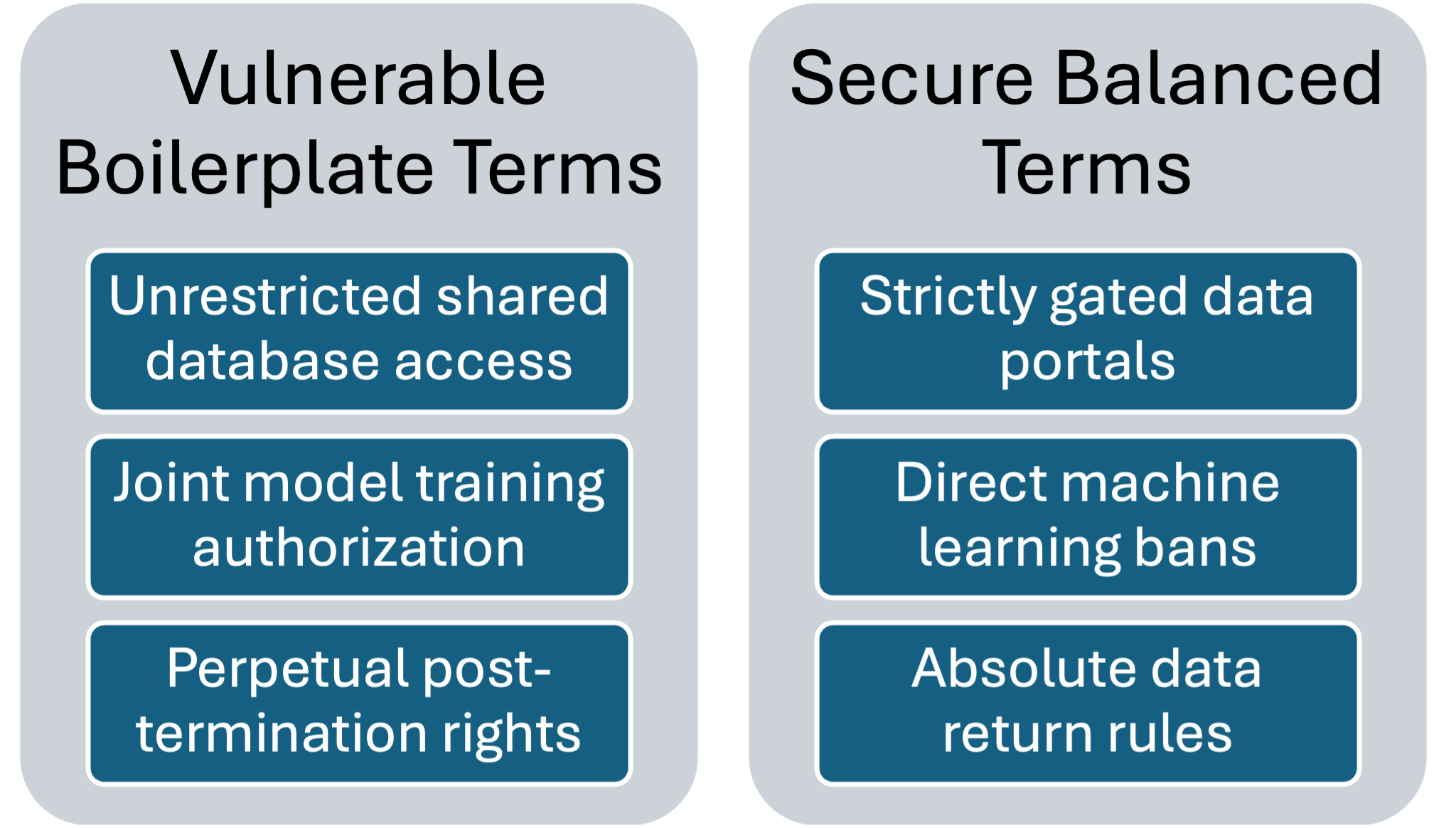
Allowing a partner unrestricted access to your live data streams introduces significant data privacy and commercial exposures. If your partner routes your proprietary operational metrics into their own external AI models or data infrastructure platforms, they can inadvertently use your data to optimize their core systems and compete directly against you.
Furthermore, unless your agreement contains strict Post-Termination Data Return Covenants, a former partner can legally retain and continue analyzing your data logs long after the strategic alliance has officially ended.
Strategic Action Items for Corporate Partnership Teams
Inventory and Seal All Background IP: Document and lock an exact technical list of your pre-existing software tools, patented technologies, and proprietary code before any project collaboration begins.
Establish Gated Testing Sandboxes: Create strictly isolated development environments and data portals to control exactly what code and metrics are accessible to your partner's engineers.
Ban External Model and AI Training: Insert explicit contractual clauses prohibiting your partner from using any shared data, prompts, or software outputs to train their public or proprietary AI models.
Hardcode the "Project Exit" Protocol: Structure the partnership agreement with an absolute winding-down blueprint, forcing the immediate return or verified destruction of all shared data assets and the revocation of all system licenses upon termination.
Contact Our Team
This briefing is provided by Palantir Advisors, a global business and legal consulting practice. If you have questions about this briefing, or if you would like to discuss how these issues may impact your business operations, please reach out to us here.