
executive briefings
Executive Briefing / October 2024
Business Continuity and Disaster Recovery in Outsourcing: Managing Single-Vendor Dependencies, System Downtime, and Operational Resilience in Strategic Sourcing Contracts
Executive Overview
When an enterprise outsources core operational functions—such as cloud infrastructure, data processing, or customer-facing platforms—to an external service provider, it moves the daily workflow but retains the ultimate business and regulatory liability. If a third-party vendor suffers a catastrophic physical disruption, a systemic software glitch, or a cyberattack, the purchasing enterprise faces immediate operational halts, compounding financial losses, and direct exposure to regulatory penalties.
Standard vendor-provided agreements routinely use protective language, such as force majeure clauses and broad disclaimers, to shield the supplier from financial accountability during a system crash. This briefing analyzes the critical legal traps hidden within vendor disaster recovery frameworks and outlines the practical, contractual strategies required to enforce supplier resilience, mandate data redundancy, and secure operational continuity before an outage occurs.
Critical Risk Vector: The Boilerplate "Force Majeure" Trap
One of the most dangerous legal blind spots in an outsourcing transaction is accepting a vendor’s standard, generic definition of an excusable delay or network failure.
The Exposure: Standard vendor contracts feature broad force majeure text that treats software glitches, cyberattacks, network routing failures, and power grid drops as unpreventable "acts of God".
The Transactional Impact: When a third-party platform goes offline due to a flawed system update or a security breach, the vendor can invoke these clauses to legally freeze their operational obligations. This leaves your enterprise completely stranded, facing extended downtime with zero contractual recourse, no access to real-time status updates, and no ability to claim financial credits for lost business.
The Contractual Remedy: Sourcing teams must strictly limit the scope of excusable delays. Contracts must explicitly state that cyberattacks, software errors, configuration mistakes, and localized infrastructure outages never constitute force majeure events if they could have been prevented by standard industry security controls or redundant operational planning.
Structural Stability Vector: Enforcing Technical Recovery Time Objectives (RTOs)
Outsourcing agreements must move past vague, high-level promises of "regular backups" and hard-code specific, legally binding recovery performance metrics directly into the service contract.
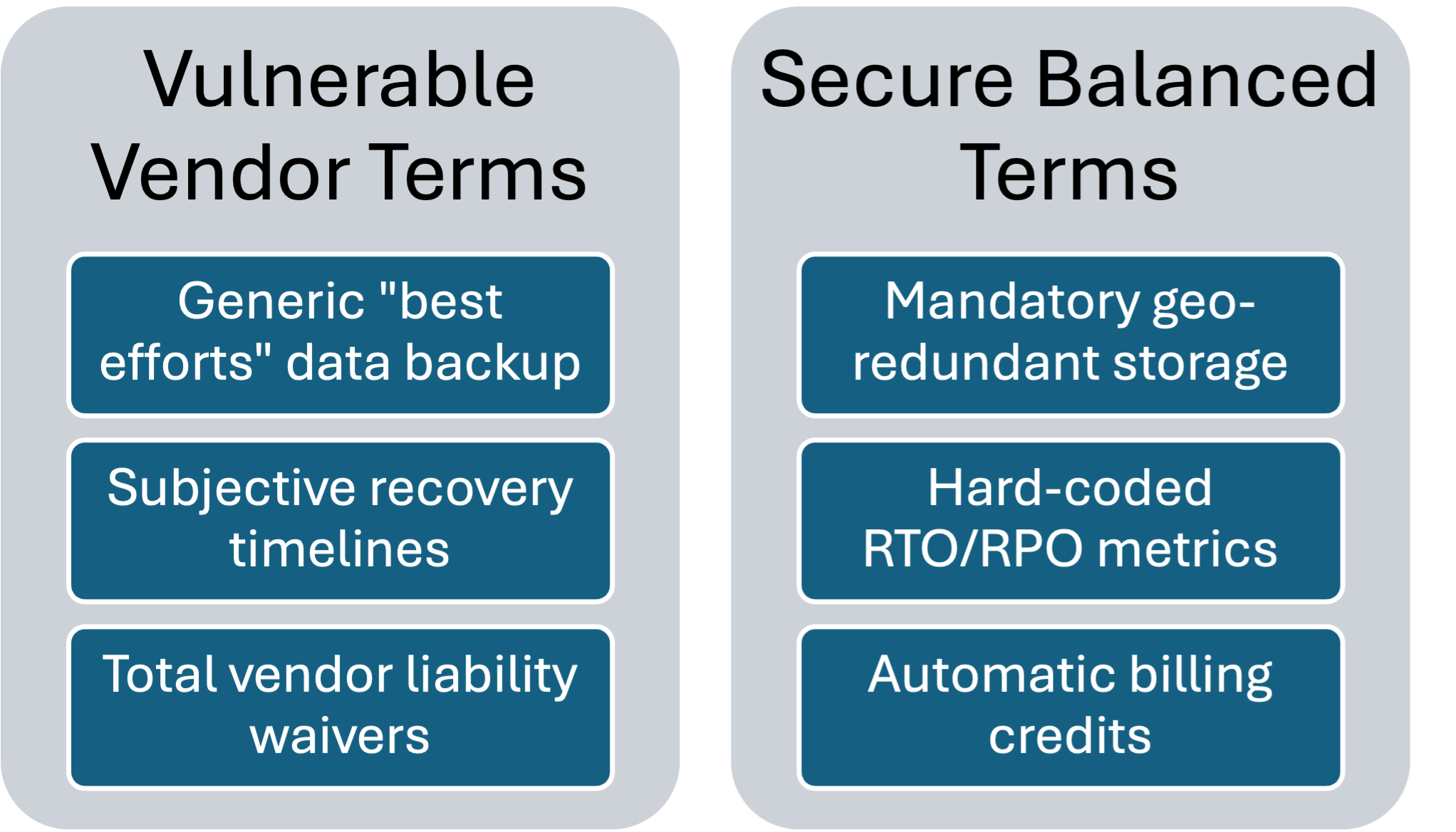
The master service agreement must explicitly define two critical technical metrics: Recovery Time Objective (RTO)—the absolute maximum number of hours the system can remain offline before triggering deep financial penalties—and Recovery Point Objective (RPO)—the maximum age of the data files that must be successfully recovered from backup servers.
Furthermore, for high-stakes business functions, the contract must mandate geo-redundant data mirroring, compelling the provider to replicate your operational data pools in real time across a completely separate physical network and geographic region to guard against localized physical destruction.
Strategic Action Items for Corporate Sourcing Teams
Deconstruct Force Majeure Exceptions: Rewrite master supplier terms to ensure that vendor-side cyber incidents and system configuration errors are explicitly excluded from contract relief.
Hardcode Binding RTO and RPO Metrics: Insert precise, time-gated system recovery deadlines directly into your Service Level Agreements (SLAs), backed by automated billing credits.
Mandate Independent Geo-Redundancy: Require the provider to legally warrant that your enterprise data is backed up continuously across completely independent physical locations and distinct power grids.
Secure "Step-In" Data Rights: Draft clear provisions granting your internal IT security teams the right to bypass vendor infrastructure and directly extract your hosted data registries during an extended, unresolved supplier outage.
Contact Our Team
This briefing is provided by Palantir Advisors, a global business and legal consulting practice. If you have questions about this briefing, or if you would like to discuss how these issues may impact your business operations, please reach out to us here.