
executive briefings
Executive Briefing / January 2024
The Disengagement Emergency: Structuring Critical Transition Support, Third-Party Cooperation, and Data Return Covenants in Commercial Technology Agreements
Executive Overview
When an enterprise decides to wind down a commercial relationship with a technology vendor, cloud provider, or outsourced services supplier, the transition phase represents the point of maximum operational vulnerability. Whether a contract expires naturally, is cancelled due to a strategic shift, or is terminated due to a commercial dispute, the purchasing enterprise faces a catastrophic operational risk if the vendor simply "turns off the lights" on the termination date. The core challenge during a disengagement is not merely shutting down the legacy application, but safely migrating the existing architecture to an alternative supplier or an internal private stack.
Standard vendor-provided agreements routinely state that all system access, application support, and data hosting services will cease immediately upon contract termination. This structural trap allows legacy providers to use the threat of sudden business shutdown as leverage to force unfavorable contract renewals or extract excessive exit fees. This briefing analyzes the critical legal risks embedded in software and infrastructure disengagement and outlines practical, contractual strategies to ensure your business is never left stranded during a cross-vendor system cutover.
Critical Risk Vector: The Continuity Trap and Competitor Sabotage
One of the biggest risks in a technology exit scenario is the absolute loss of system functionality before a replacement supplier's platform is fully tested and live.
The Exposure: Migrating core business records, customer-facing websites, or complex enterprise resource platforms onto an alternative supplier's infrastructure is a complex operational process that frequently hits unexpected delays. If your master agreement permits the incumbent vendor to cut off access the moment a cancellation notice is filed, your day-to-day business operations can grind to a complete halt.
The Transactional Impact: A sudden loss of system access strips your procurement team of its negotiating leverage, exposes you to immediate operational losses, and forces your business to accept expensive short-term pricing extensions just to survive the migration gap.
The Contractual Remedy: Sourcing teams must hard-code a comprehensive, non-negotiable Disengagement Assistance Clause into the body of the master agreement. This clause must legally compel the vendor to provide continuous, uninterrupted system uptime, standard application functionality, and routine maintenance for a specified post-termination window—typically 90 to 180 days—regardless of the reason for the contract split.
Structural Stability Vector: Mandatory Third-Party Cooperation and Data Portability
A robust transition framework must explicitly compel the incumbent vendor to actively coordinate with your incoming technology provider to execute a seamless transfer of services.
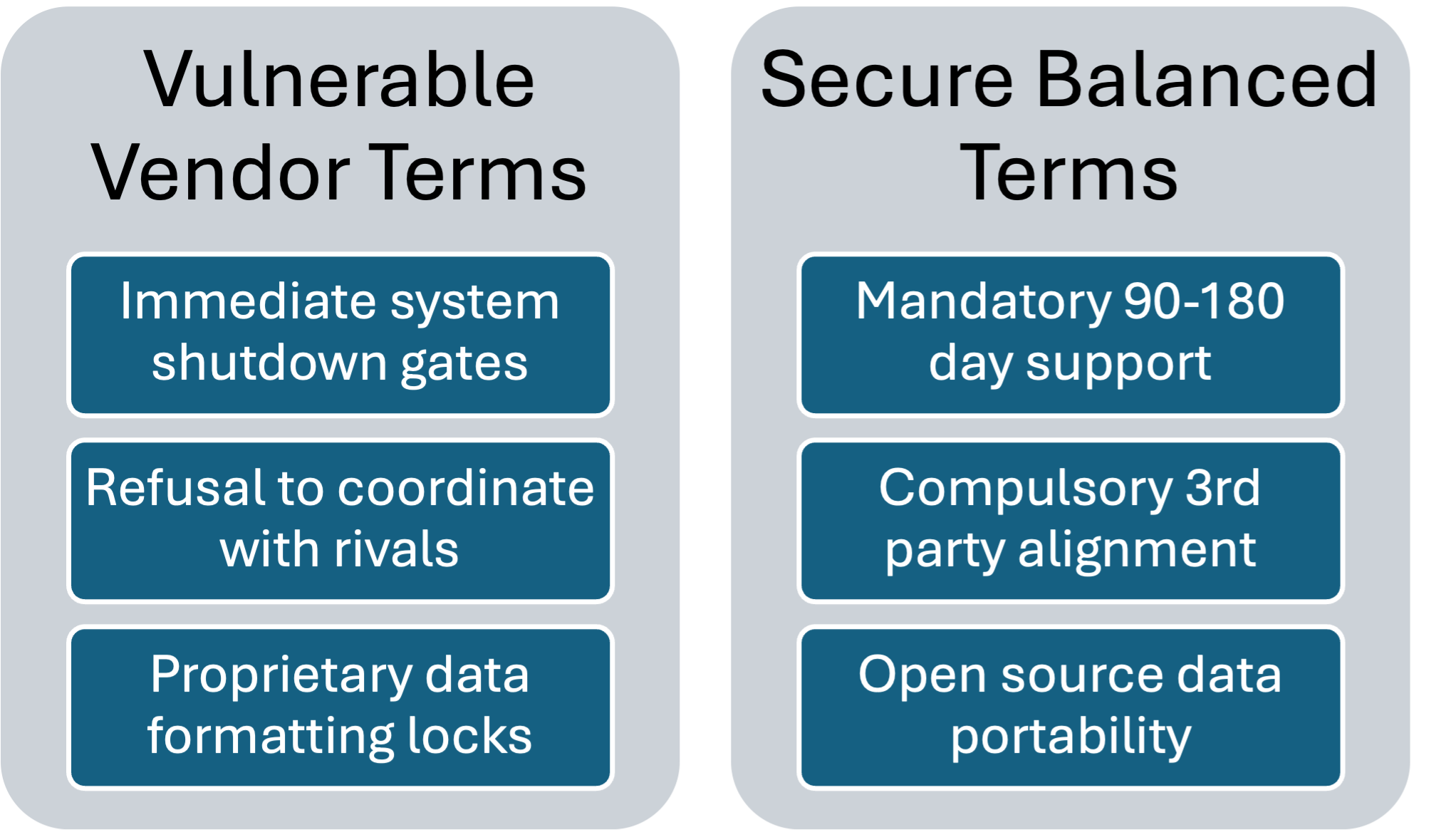
Incumbent suppliers frequently attempt to stall migrations by refusing to share environment documentation or communicate with a competing technology vendor, claiming intellectual property or confidentiality barriers. To neutralize this tactic, the contract must include an absolute Obligation of Cooperation. This covenant legally requires the incumbent provider to work directly with your designated third parties—including newly appointed suppliers, technical consultants, and independent cloud auditors—to hand over system registries, explain data mapping layers, and participate in joint cutover planning meetings.
To achieve a balanced, market-aligned compromise that prevents your enterprise from being left stranded during this cross-vendor handoff, transactional lawyers can structure a Pay-in-Advance Safety Clause. If the contract is being terminated because of a payment dispute or a customer default, the vendor cannot simply shut down your access or halt third-party cooperation. Instead, the supplier must be contractually obligated to continue providing transition support and coordinating with your alternative provider, provided your team pays for those specific post-termination transition services weekly or monthly in advance.
Furthermore, the disengagement covenants must place strict technical obligations on the vendor regarding data return:
The Data Return Mandate: The vendor must securely export and return all corporate data registries, user files, and configuration configurations within a specified timeframe (e.g., 10 days of a request).
Open Data Formats: The supplier must deliver your records to you or your designated new supplier in standard, open-source formats rather than locking your assets behind proprietary vendor code configurations.
Verified System Purging: Once the alternative supplier verifies that the data migration is complete and fully functional, the incumbent must provide written, certified proof that all copies of your data have been permanently erased from their backup systems.
Strategic Action Items for Corporate Sourcing Teams
Mandate Continuity Regardless of Reason: Ensure that the vendor's obligation to provide transition assistance applies to all terminations, including defaults and non-payment disputes.
Lock In Compulsory Third-Party Integration: Insert explicit terms compelling the incumbent supplier to share interface keys, mapping sheets, and configuration data directly with your designated new tech provider.
Embed the Pay-in-Advance Compromise: Insert clear clauses allowing the vendor to request advance payment for the transition window if the contract is being cancelled due to a customer-side financial default.
Eradicate Proprietary Data Locks: Require the technology provider to warrant that all outbound data files will be delivered in readable, standard formats with full data schema documentation.
Fix Transition Service Pricing Rates: Hard-code the exact financial rates for transition support within the initial contract schedules, preventing the vendor from charging predatory fees during an exit window.
Contact Our Team
This briefing is provided by Palantir Advisors, a global business and legal consulting practice. If you have questions about this briefing, or if you would like to discuss how these issues may impact your business operations, please reach out to us here.