
executive briefings
Executive Briefing / July 2023
Managing Subcontractor Risks in Commercial Transactions: Navigating Chain-of-Custody Liability, Flow-Down Covenants, and Supplier Veto Rights in Strategic Sourcing Contracts
Executive Overview
When an enterprise engages an outsourced provider or technology vendor, the contract is negotiated based on that specific supplier’s financial stability, data security baselines, and operational expertise. However, behind the primary vendor's interface frequently lies a vast network of unmonitored third-party subcontractors, offshore data processors, and independent software technicians.
Allowing a vendor to quietly re-delegate its contractual obligations creates deep operational and legal exposures. If a subcontractor experiences a data breach, drops service levels, or violates regulatory trade rules, the primary corporate customer remains entirely liable for the cascading fallout.
This briefing analyzes the critical compliance traps hidden within standard, vendor-favorable subcontracting frameworks. It outlines practical, contractual strategies to enforce complete visibility, restrict unilateral delegation, and lock in absolute supplier accountability before any third party touches your corporate assets.
Critical Risk Vector: The Blind Supply Chain Gap
One of the biggest risks in commercial transactions is granting a vendor unvetted, discretionary rights to appoint subcontractors.
The Exposure: Standard vendor templates routinely state that the provider may use any third-party supplier or offshore entity to fulfill their obligations without needing your prior written consent.
The Transactional Impact: Your core business operations, sensitive data streams, and customer files are quietly exposed to entities you have never evaluated. If an unmapped subcontractor drops performance standards, breaks compliance rules, or experiences network downtime, your business continuity is immediately compromised.
The Contractual Remedy: Sourcing teams must hard-code a formal Subcontractor Governance Framework into the body of the master agreement. This framework mandates that any third party assisting the vendor must be explicitly cleared, logged, and controlled.
Structural Stability Vector: Tiered Approvals, Flow-Down Terms, and Accountability Chains
To control vendor behavior and insulate your operating perimeters, your contract must establish clear tiering structures that separate critical subcontractors from routine corporate utilities.
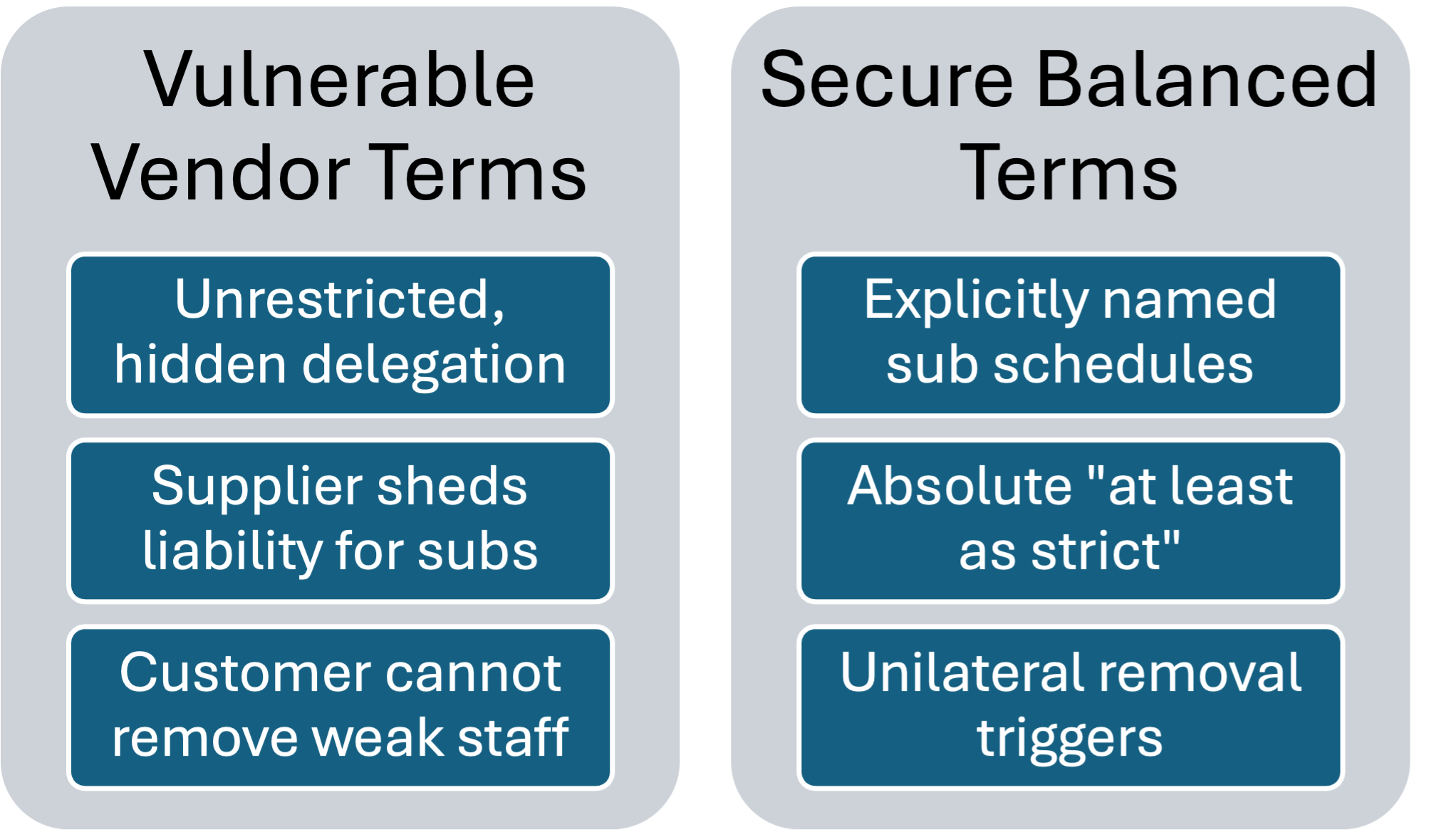
Transactional lawyers must structure these subcontractor covenants around four core operational principles:
The Named Subcontractor Schedule: For subcontractors providing material services, accessing sensitive customer data, or dedicated to your specific account, the contract must list them explicitly by name, including a detailed description of the exact tasks they are authorized to perform.
Tiered Replacement & Veto Rights: The vendor must be contractually barred from swapping out or adding a material subcontractor without providing advanced written notice (e.g., 30 days) and submitting full technical profiles. For customized outsourcing projects or dedicated technical services, any changes to the named subcontractor list should be subject to your prior written approval. Conversely, for standardized cloud hosting or infrastructure platforms operating on a shared model, individual customers cannot realistically veto supplier choices; in these transactions, the framework must instead focus on securing advanced notice windows and giving your enterprise the explicit right to exit the agreement without penalty if a newly appointed supplier fails to meet your corporate security criteria. Moreover, for routine corporate utilities (such as the vendor's office internet provider), a basic retrospective notification protocol may apply.
The "At Least As Protective" Flow-Down Mandate: Sourcing agreements must legally compel the primary vendor to pass down all confidentiality, data protection, cybersecurity, and regulatory requirements into their contracts with subcontractors. The vendor must warrant that all subcontractor agreements contain legal terms at least as protective as the master contract signed with your business.
Absolute Primary Responsibility: The primary vendor must remain completely and unconditionally liable for the performance, acts, omissions, and regulatory compliance of all its subcontractors, completely blocking any vendor attempts to shift blame down the supply chain.
The Right to Request Removal or Exit: In customized outsourcing or dedicated development arrangements, your firm should retain the right to demand the immediate removal and replacement of any assigned subcontractor demonstrating a performance gap or security vulnerability. For standardized cloud hosting and shared software platforms where individual removal is operationally impossible, this right must instead transform into an expedited exit trigger; if an audit or event reveals a security defect with a provider's infrastructure subcontractor, your enterprise must have the unilateral right to terminate the agreement immediately with zero financial penalty and full data portability.
Strategic Action Items for Corporate Sourcing Teams
Lock In Named Supplier Schedules: Formally list and authorize all critical subcontractors and offshore data centers within an attached contract schedule before executing the agreement.
Enforce Absolute Flow-Down Rules: Require the vendor to deliver written proof or signed verifications confirming that their subcontractors are bound by equivalent privacy and data protection mandates.
Vendor Liability for Subcontractors: Ensure that any losses or regulatory fines resulting from a subcontractor's breach or failure are backed by a primary vendor indemnity pool.
The Right to Eject or Terminate Access: In customized service arrangements, secure a clear provision granting your project managers the right to require the immediate removal of any non-compliant third-party from your account without needing to prove a contractual default. For shared cloud environments, this must be structured as an immediate right to suspend data feeds and pull your data registries out of the platform without penalty if a vendor's subcontractor compromises system integrity.
Contact Our Team
This briefing is provided by Palantir Advisors, a global business and legal consulting practice. If you have questions about this briefing, or if you would like to discuss how these issues may impact your business operations, please reach out to us here.