
executive briefings
Executive Briefing / April 2023
Structuring Corporate Termination Rights in Technology Transactions: Moving Beyond Material Breach to Enforce Commercial Flexibility, Service Compliance, and Strategic Exit Routes
Executive Overview
When an enterprise enters into a high-value commercial technology transaction—such as a large-scale software deployment, cloud infrastructure agreement, or strategic outsourcing contract—contractual exit pathways are frequently treated as standard boilerplate provisions. Standard vendor-provided agreements routinely restrict a customer's right to exit, limiting cancellation paths exclusively to a single, narrow trigger: a material breach that remains uncorrected after an extended warning period.
Accepting these one-sided parameters leaves an enterprise severely exposed. Waiting weeks for a vendor to correct a major system error can cause significant operational downtime, while sudden shifts in your own corporate strategy or the provider's financial health can lock you into an unviable relationship.
This briefing analyzes the critical legal risks embedded in rigid exit frameworks and outlines practical, contractual strategies to secure diverse, multi-layered termination rights before signing.
Critical Risk Vector: The Single-Breach Compliance Loop
A key risk in technology procurement is the "remediation loophole," where a vendor repeatedly commits distinct service failures but corrects each individual error just before a formal breach deadline is reached.
The Exposure: Standard vendor terms require a customer to provide formal notice of a material breach and grant the provider 30 days to fix the issue. If the vendor temporarily patches the problem, the exit clock resets, leaving the customer trapped in a continuous loop of poor service performance.
The Transactional Impact: Sourcing teams find themselves tied to underperforming suppliers with zero contractual leverage to demand a clean break, resulting in ongoing operational disruption and budget waste.
The Contractual Remedy: Sourcing agreements must expand the definition of exit triggers. Contracts should explicitly state that a series of minor service failures, which collectively demonstrate a systemic failure to perform, will automatically constitute a material breach and allow for an immediate termination of the relationship.
Structural Stability Vector: Multi-Tiered Exit Triggers & Commercial Balances
To control vendor behavior and insulate your operational perimeters, your contract must feature clear, objective exit triggers that handle strategic corporate changes, operational service drops, and unexpected market shifts.
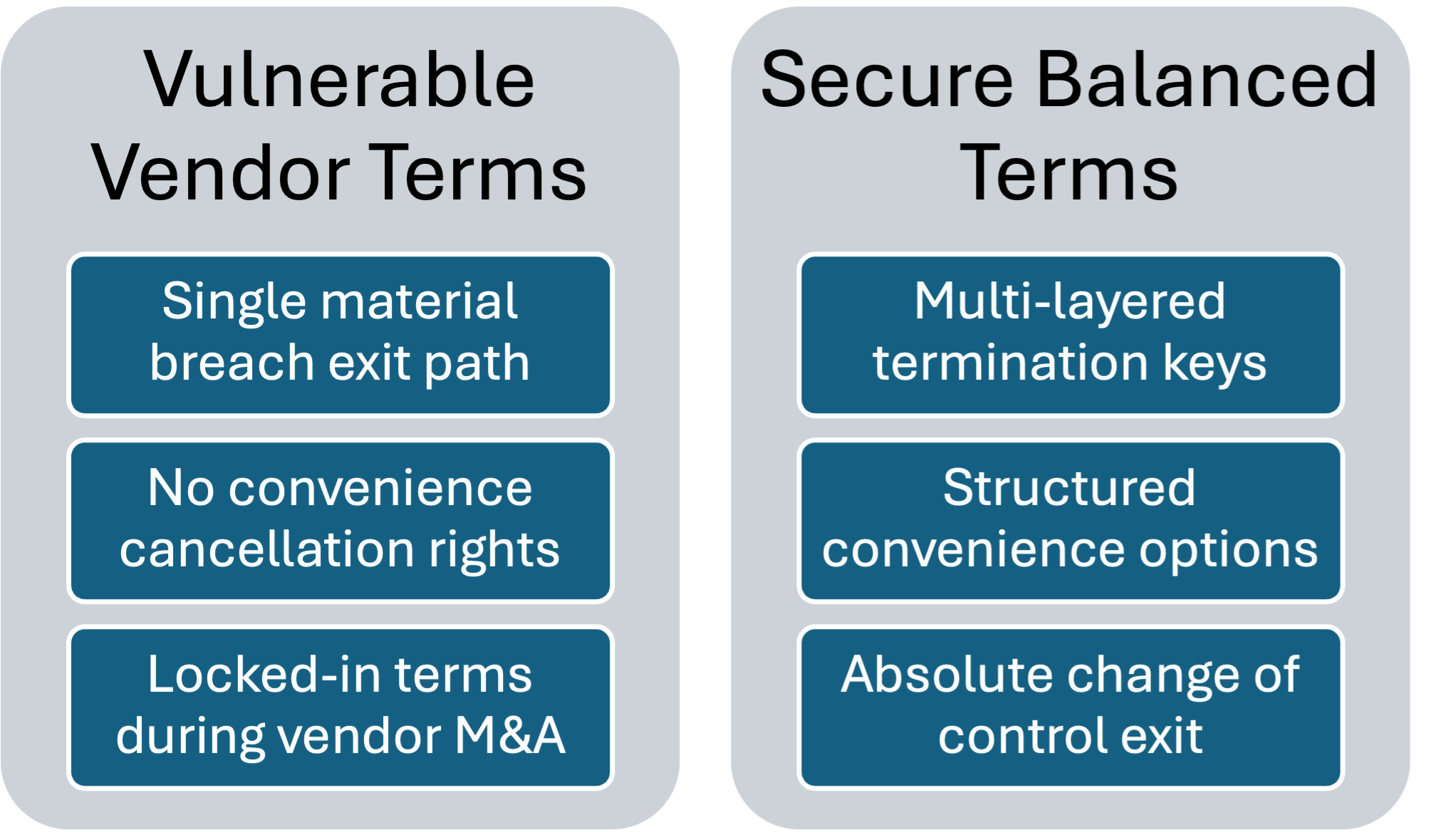
Transactional lawyers must structure these exit pathways around specific commercial scenarios, tailoring the remedy to the exact nature of the platform transaction:
Bright-Line Service Level Exits: The contract must state that missing specific, key performance metrics (e.g., system uptime falling below a set percentage) across a defined window (such as three misses within any rolling six-month period) automatically grants your enterprise the right to exit the contract immediately without penalty.
The Convenience Exit Compromise: Your sourcing team should seek a unilateral right to terminate the contract for convenience at any time. To reach a balanced market compromise, this right can be tied to a reasonable notice period (e.g., 60 to 90 days) and a structured early termination fee that scales down over the life of the agreement, reflecting the supplier's unrecovered setup costs.
Corporate Restructuring and M&A Routes: The agreement must provide an immediate termination path if your enterprise undergoes a corporate merger, acquisition, or internal restructuring that makes the vendor's software redundant.
Vendor Financial Stability Controls: Secure an immediate exit trigger if the vendor files for bankruptcy, faces insolvency proceedings, or demonstrates a severely degraded financial condition that threatens their ability to maintain standard technical service levels.
Change of Control Protections: If the technology provider is acquired by a direct competitor of your enterprise, the contract must grant your firm the right to cancel the agreement immediately to prevent trade secret and asset exposure.
Extended Force Majeure Escapes: While standard terms pause performance during major global disruptions, your contract must state that if an excusable delay continues for an extended window (e.g., exceeding 30 consecutive days), your enterprise has the right to terminate the agreement instantly with zero penalty.
Strategic Action Items for Corporate Sourcing Teams
Incorporate Collective Breach Language: Ensure your master agreements state that numerous individual service failures will collectively constitute a material breach, allowing for immediate cancellation.
Objective SLA Exit Triggers: Link your system service level metrics directly to automatic exit rights, bypassing standard multi-week vendor correction windows.
Negotiate Change of Control Escapes: Insert explicit terms allowing your team to dissolve the relationship instantly if the vendor is sold to a market rival.
Secure Continued Transition Support: Confirm that invoking any valid exit trigger automatically activates the vendor's obligation to provide comprehensive disengagement assistance and secure data return.
Contact Our Team
This briefing is provided by Palantir Advisors, a global business and legal consulting practice. If you have questions about this briefing, or if you would like to discuss how these issues may impact your business operations, please reach out to us here.