
executive briefings
Executive Briefing / January 2023
Structuring Supplier Infringement Indemnity: Mitigating Regulatory and Contractual Carve-Out Risks, Enforcing Remedial Obligations, and Securing Procedural Control Rights
Executive Overview
In enterprise technology transactions, the intellectual property (IP) indemnities offered in standard vendor templates are frequently compromised by downstream exceptions. While a contract may explicitly state that a supplier will defend against third-party IP claims, boilerplate provisions regularly narrow this protection. Vendors routinely insert broad carve-outs, restrict operational remedies, and exclude customers from litigation strategy.
Accepting these restricted terms exposes an enterprise to material financial liability, unexpected operational injunctions, and unrecoverable defense costs. Securing robust protection requires isolating the substance of the indemnity obligation, ensuring operational continuity, and establishing rigorous procedural oversight over the defense process.
Critical Risk Vector: The Carve-Out Loophole
The primary vulnerability in intellectual property indemnification negotiations resides in the scope of the exceptions. Vendors frequently utilize broad exclusions to completely absolve themselves of the duty to defend when an actual claim arises.
The Exposure: Standard vendor terms routinely state that the supplier has zero liability if the infringement claim involves:
Data or content uploaded and processed by the customer.
The customer using the software outside strictly documented parameters.
The integration of the vendor's platform with third-party hardware, software, or business processes not explicitly provided by the vendor.
The Transactional Impact: Because modern enterprise platforms rarely operate in isolation, a vendor can almost always argue that a third-party claim is tied to your broader infrastructure or data stack. This effectively shifts the entire litigation and liability burden back to your enterprise.
Structural Stability Vector: Substantive Integrity & Procedural Oversight
To protect your operational perimeter, your IP indemnity framework must limit vendor exemptions while simultaneously establishing strict remediation rules and clear procedural control rights.
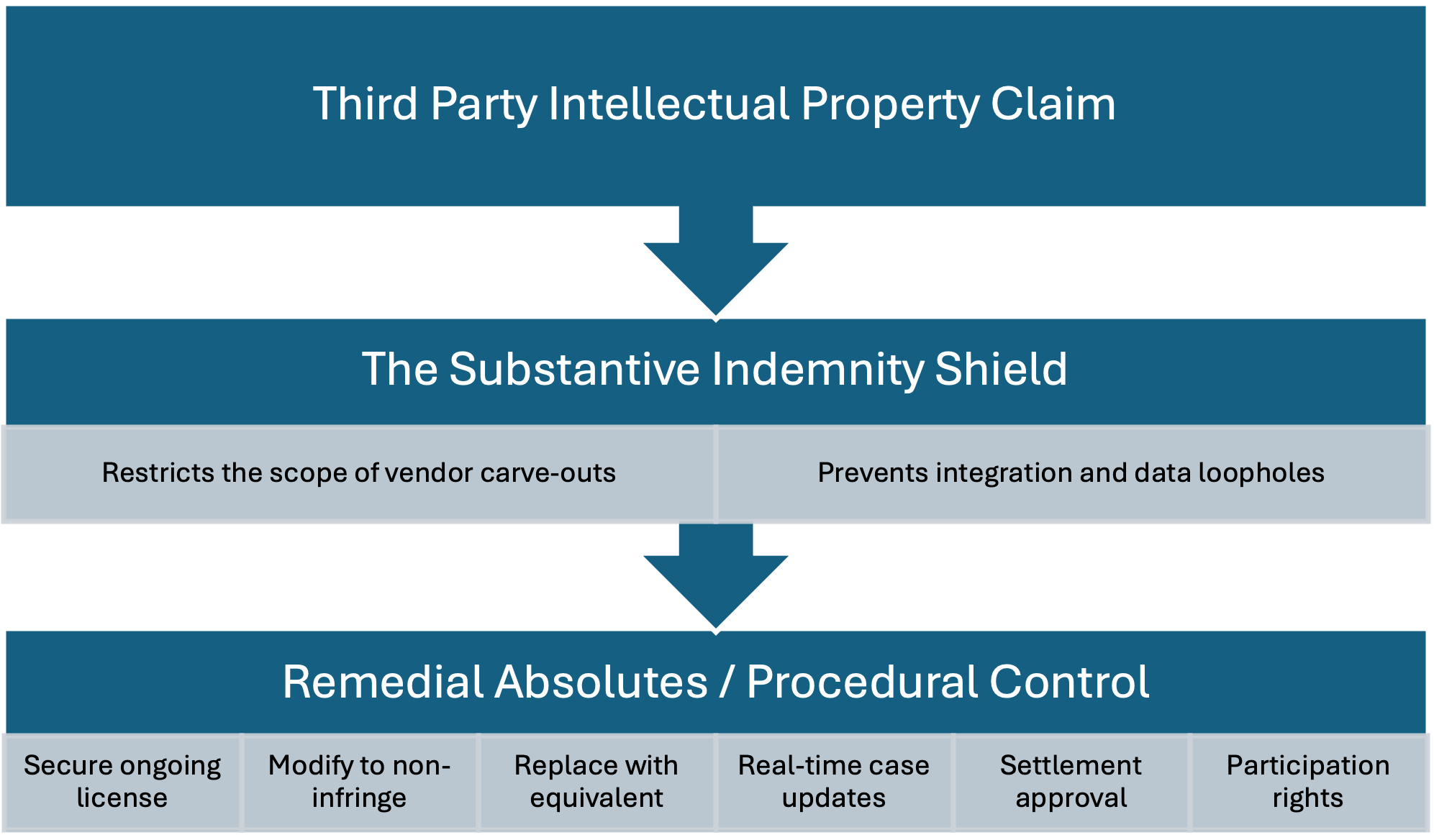
The Substantive Indemnity Matrix
Sourcing teams must structure the IP indemnity around three distinct protective layers:
Restricting the "Combination" Carve-Out: Modify the standard integration carve-out to state that the vendor remains fully liable unless the infringement claim would only arise from the third-party product when completely separated from the vendor’s technology. The contract must explicitly cover all standard, intended, or predictable configurations.
The Mandatory Triad of Operational Remediation: If a claim or injunction threatens to disrupt your operations, the vendor must be contractually compelled to execute one of three actions immediately at their sole expense to maintain business continuity:
Procure: Secure the legal right and license for your enterprise to continue using the technology seamlessly.
Modify: Alter the technology so it becomes non-infringing, provided the modification causes zero reduction in performance, security, or core functionality.
Replace: Swap out the infringing material with a non-infringing, functionally equivalent alternative.
Procedural Safeguards and Oversight
A balanced indemnity framework must replace unilateral vendor control over the legal defense with transparent customer oversight:
The Informational Obligation: The supplier must be contractually obligated to keep your legal team fully informed of all litigation milestones, filings, and strategies in real time. This ensures active oversight and prevents the mismanagement of a case that risks your reputation.
The Settlement Approval Right: The contract must state that the supplier cannot enter into any settlement that imposes any financial liability, admits fault, or places behavioral or operational restrictions on your enterprise without your explicit, written consent.
The Right to Participate: While the vendor remains financially responsible for the core defense, the agreement must explicitly grant your enterprise the right to retain separate, independent legal counsel to participate in the defense at your own expense. This guarantees your corporate interests are directly represented in the proceedings.
Enhanced Risk-Mitigation Controls for Strategically Important Transactions
For high-value, business-critical agreements where an intellectual property dispute poses severe operational or regulatory exposure, sourcing teams should consider deploying these additional contractual safeguards:
Construct a Remediation Escrow Trigger: Require a percentage of annual licensing fees to be redirected into an escrow account immediately upon the formal filing of a third-party IP lawsuit. This secures immediate liquidity to fund alternative procurement if the vendor fails to resolve the claim within the mandatory remediation window.
Establish Fallback Thresholds in Playbooks: Incorporate a structured negotiation hierarchy for the "combination" carve-out. If the vendor refuses absolute liability for third-party integrations, fall back to a shared-fault allocation model determined by the proximate cause of the infringement claim.
Define Metric Baselines for Performance Parity: Append a technical baseline matrix directly to the indemnity clause. This matrix must log current computing throughput, latency, and data-processing metrics to serve as the binding benchmark for evaluating whether a modified or replaced system meets the contract's "functionally equivalent" standard.
Pre-Authorize Defense Counsel Panels: Insert a pre-approved list of neutral, top-tier law firms directly into the contract boilerplate. This eliminates delays and tactical disputes regarding the definition of "acceptable independent counsel" if your enterprise exercises its right to separate representation.
Mandate Source Code Escrow with IP Release: Link the master agreement to a three-party source code escrow framework. The escrow terms must specify that if a court issues an injunction due to vendor infringement and the vendor fails to provide a non-infringing workaround, the source code will immediately release to your enterprise to allow internal developers to patch or maintain the system.
Contact Our Team
This briefing is provided by Palantir Advisors, a global business and legal consulting practice. If you have questions about this briefing, or if you would like to discuss how these issues may impact your business operations, please reach out to us here.