
executive briefings
Executive Briefing / July 2022
Structuring Dynamic Commercial Value Controls: Deploying Benchmarking Rights and Most Favored Customer Clauses in Long-Term Technology Agreements
Executive Overview
In enterprise technology transactions, maintaining market-competitive pricing and service performance across multi-year lifecycles presents a significant operational challenge. Standard vendor templates routinely lock in static pricing structures or minimal, predictable discounts that fail to account for broader market shifts, macroeconomic deflation, or technological efficiencies.
Accepting these inflexible financial parameters risks exposing an enterprise to overpayment as market rates decline or as the vendor scales its operations. To safeguard long-term commercial value, corporate negotiating teams should consider pushing for a dual-layered framework combining formal benchmarking rights with Most Favored Customer (MFC) clauses. These mechanisms assist in ensuring that long-term contracts adapt to evolving market realities, keeping costs and service baselines strictly competitive.
Critical Risk Vector: The Static Pricing Trap and Market Divergence
A primary vulnerability in multi-year technology agreements is the "commercial divergence loophole," where contractual pricing remains constant while the broader market cost for identical performance decreases.
The Exposure: Under a standard fixed-rate contract, an enterprise remains bound to pricing negotiated years prior, even if the vendor introduces more efficient architectures or lowers prices for new clients. Without structured adjustment mechanisms, the customer effectively subsidizes the vendor’s improved margins.
The Transactional Impact: Sourcing teams face an economic disadvantage, locked into uncompetitive pricing structures with no contractually enforceable leverage to demand market alignment, resulting in ongoing financial inefficiency.
Structural Stability Vector: Sizing the Deal and Target Environments
While benchmarking and MFC clauses provide substantial commercial protection, they require significant administrative oversight and vendor concessions. Sourcing teams should consider focusing these demands on specific transaction types where they are both highly impactful and realistic to secure.
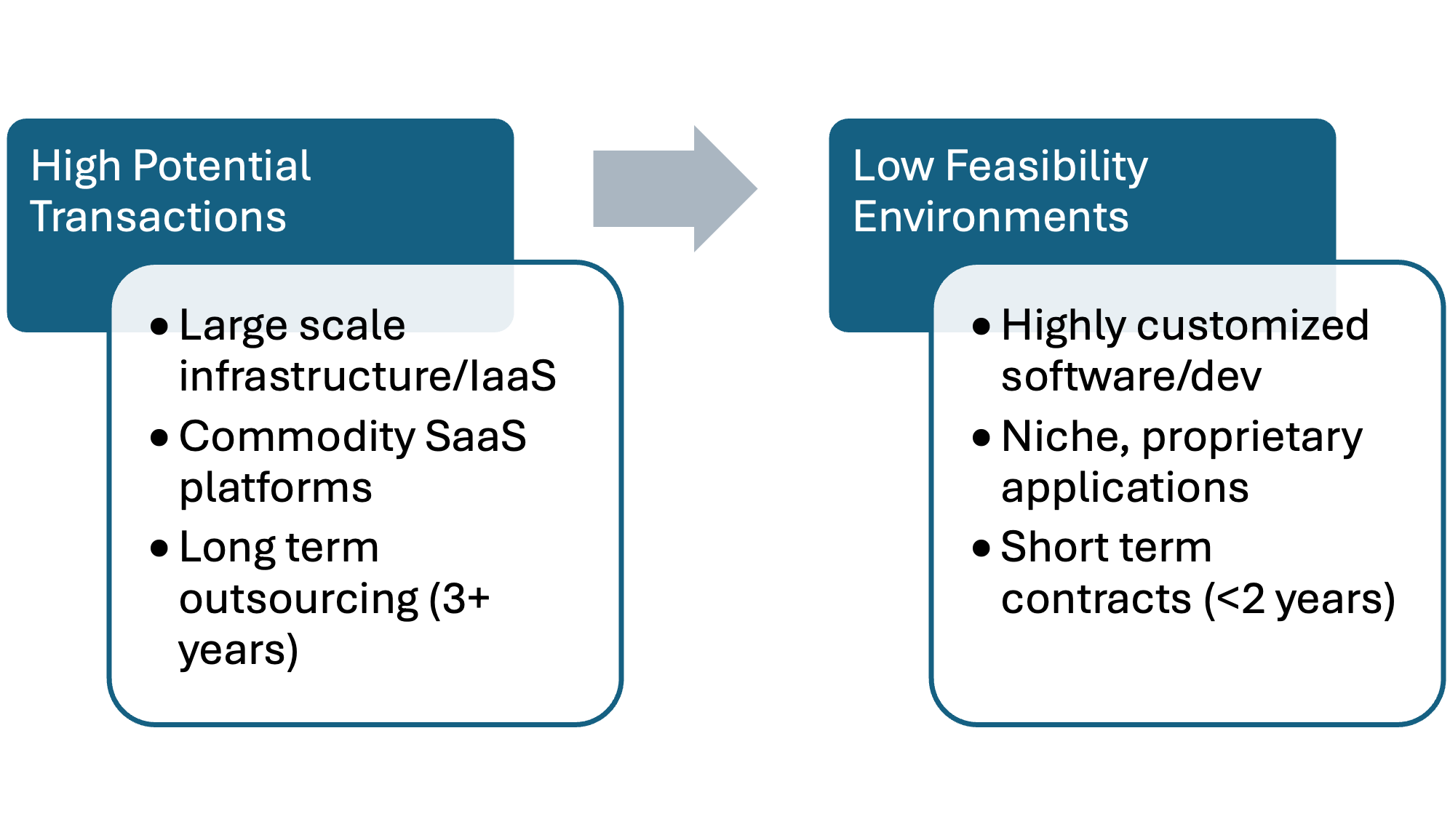
Determining Deal Feasibility
Negotiating teams should consider prioritizing these mechanisms within specific transactional parameters:
High-Volume Commodity SaaS and Infrastructure (IaaS): Benchmarking and MFC protections are more realistic in standard, high-volume cloud or hosting transactions. Because the service offerings are relatively uniform across the industry, third-party data is readily available to compare against prevailing market rates.
Strategic Outsourcing and Managed Services: For multi-year IT infrastructure or business process outsourcing contracts exceeding three years, benchmarking is a standard market expectation to ensure service levels and pricing do not stagnate.
Transactions Over Threshold Spend: Vendors are significantly more likely to accept these administrative burdens when the total contract value meets an enterprise-defined threshold (e.g., exceeding $1,000,000 in annual recurring spend).
Structural Mechanics: Benchmarking vs. Most Favored Customer Clauses
To protect the enterprise's financial baseline, transactional lawyers should consider structuring these provisions to operate as independent yet complementary commercial adjusters.
The Benchmarking Protocol
Sourcing teams should consider defining the benchmarking process as an objective, third-party operational audit:
Independent Third-Party Selection: Sourcing playbooks often recommend that the comparison be conducted by an independent, mutually agreed-upon research firm or consultant, ensuring the data remains neutral.
The Performance Parity Requirement: The clause should explicitly state that the benchmark will compare pricing against a peer group of users with similar transaction volumes, service level agreements (SLAs), and operational complexities.
Mandatory True-Down Mechanisms: If the benchmarking review reveals that the vendor's pricing is higher than the market average by a set variance (e.g., exceeding 5%), the contract should require the vendor to automatically lower its rates to match the market baseline within a strict timeframe.
The Most Favored Customer (MFC) Assurance
An MFC clause provides an ongoing contractual warranty regarding pricing integrity:
Continuous Pricing Alignment: Sourcing teams should consider pushing for language requiring the vendor to certify that the pricing, terms, and discounts granted to your enterprise are no less favorable than those offered to any other customer with a comparable or smaller purchase volume.
Automatic Adjustment Triggers: The clause should dictate that if the vendor offers a lower rate to a comparable tier of customer, that identical rate will automatically apply to your agreement moving forward.
Annual Audit and Certification Rights: To ensure compliance, negotiating teams should consider seeking a right for an annual executive certification from the vendor confirming adherence to the MFC parameters.
Enhanced Risk-Mitigation Controls for Commercial Value Alignment
For critical, long-term agreements where continuous cost competitiveness is targeted, sourcing teams should consider deploying these additional structural safeguards:
Incorporate a Benchmarking Exit Right: Sourcing teams should consider pushing for an explicit right to terminate the agreement without penalty if a benchmarking exercise identifies a material price discrepancy and the vendor refuses to adjust its pricing to match the market average within 30 days.
Establish a Restricted Vendor Peer Group Definition: To prevent the vendor from diluting the benchmarking pool, teams should consider pre-defining the acceptable peer group metrics (e.g., Fortune 500 enterprises with similar user counts) directly in the contract appendix.
Structure a "Look-Back" Audit Trigger: For high-value transactions, consider a mechanism where an MFC violation discovered during an annual review triggers an automatic retroactive credit or cash true-up for the period during which the higher pricing was erroneously applied.
Link Benchmarking to Service Level Upgrades: Moving beyond pure financial metrics is an alternative worth exploring. Sourcing teams should consider pushing for language specifying that benchmarking can also evaluate service delivery metrics, forcing the vendor to upgrade technical performance if industry standards evolve.
Contact Our Team
This briefing is provided by Palantir Advisors, a global business and legal consulting practice. If you have questions about this briefing, or if you would like to discuss how these issues may impact your business operations, please reach out to us here.