
executive briefings
Executive Briefing / April 2022
Modernizing Force Majeure Frameworks: Insulating Enterprise Tech Transactions Against Supply Chain Disruption, Trade Friction, and Public Health Mandates
Executive Overview
In enterprise technology transactions, the Force Majeure (FM) clause has evolved from a standard boilerplate provision into a critical commercial risk-allocation tool. Historical contract templates routinely relied on broad, generic definitions of "Acts of God" to excuse a party's non-performance.
Accepting these legacy frameworks leaves a modern enterprise severely exposed. Ongoing global supply chain vulnerabilities, public health containment mandates, sudden trade tariffs, and localized manufacturing shutdowns routinely disrupt tech delivery without legally qualifying as traditional, unforeseeable disasters. Protecting the enterprise requires structuring a precise, contemporary Force Majeure framework that clearly delineates predictable economic hurdles from genuine performance impossibilities, enforces operational workarounds, and secures definitive exit routes if performance stalls.
Critical Risk Vector: The Macroeconomic Excuse Loophole
A key vulnerability in outdated Force Majeure provisions is the "economic frustration loophole," where vendors attempt to invoke FM language to excuse delays or price spikes caused by shifting market friction.
The Exposure: Standard vendor terms often include broad catch-all phrasing like "acts of government," "supply shortages," or "labor disputes" within their FM definitions. If a trade war increases the cost of microchips or a regulatory change slows down hardware shipping, vendors may claim an FM event has occurred to pause performance or demand pricing renegotiation.
The Transactional Impact: Sourcing teams frequently find themselves facing indefinite project delays or unbudgeted price increases with zero contractual recourse, as the vendor shifts standard macroeconomic operating risks back onto the customer.
Structural Stability Vector: Differentiating Market Friction from Force Majeure
To preserve operational continuity, corporate negotiating teams should consider pushing for narrow, contemporary definitions that explicitly exclude foreseeable economic and geo-political adjustments from the scope of excusable non-performance.
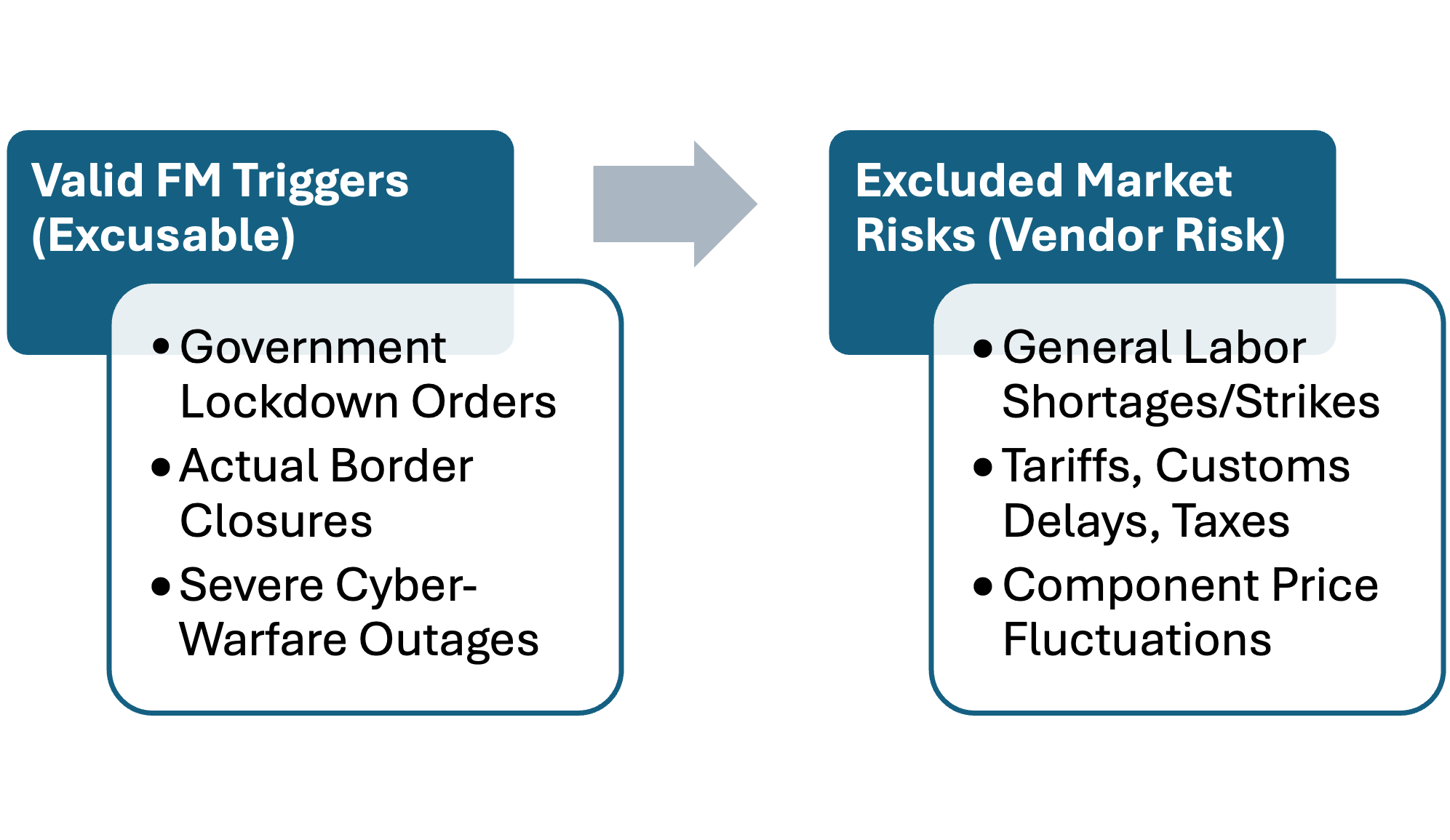
The Exclusion Matrix
Transactional lawyers should consider restructuring the FM definition around specific contemporary guardrails:
The Economic Hardship Exclusion: Sourcing playbooks recommend stating explicitly that increases in the cost of labor, materials, components, or transport do not constitute Force Majeure events. Financial unprofitability must remain a vendor risk.
The Tariff and Trade Friction Guardrail: Negotiating teams should consider pushing for language clarifying that new tariffs, customs backlogs, or trade embargoes do not excuse performance. Vendors should be contractually obligated to maintain diversified supply networks.
The Pandemic Baseline: Because public health emergencies are now fully foreseeable, contracts should specify that general viral outbreaks do not trigger FM protections. Instead, only explicit, binding government mandates that make physical performance illegal or physically impossible should be considered for temporary relief.
Structural Mechanics: Mitigating the Impact of an Active Event
When a valid, government-mandated FM event does occur, the contract must switch from a passive waiver of liability into an active operational management protocol.
Mandatory Disaster Recovery Alignment
The agreement should explicitly state that a vendor cannot invoke Force Majeure unless they have fully deployed their contractually mandated Business Continuity and Disaster Recovery (BCDR) plans. Sourcing teams should consider pushing for terms ensuring that if a secondary data center or supply facility is unaffected by the regional disruption, the vendor must transition operations there instantly at their own expense.
Allocation of Scarce Resources
During global supply chain constraints, vendors often ration remaining inventory or cloud compute capacity among their clients. Sourcing teams should consider seeking a "Pro-Rata Capacity Warranty." This clause requires the vendor to allocate its surviving services and components to your enterprise on a basis no less favorable than that provided to their most preferred customers, preventing your project from being entirely deprioritized.
Enhanced Risk-Mitigation Controls for Global Disruption Management
For critical technology deployments where extended delivery gaps cannot be tolerated, sourcing teams should consider deploying these additional structural safeguards:
Construct an Extended Force Majeure Escape Trigger: Negotiating teams should consider seeking an explicit right to terminate the agreement instantly, without penalty, if an excusable Force Majeure delay continues for a set window (e.g., exceeding 30 consecutive days).
Enforce a Dual-Sourcing Right Without Default: Sourcing teams should consider pushing for language stating that during any active FM event, the customer has the immediate right to procure equivalent software or services from a third-party competitor. The vendor must cooperate with this temporary offloading and immediately pause all related licensing or subscription fees.
Establish a Pre-Paid Fee Clawback Mechanism: For high-value transactions, consider a mechanism where any termination resulting from an ongoing FM event triggers a mandatory, pro-rata refund of all prepaid, unearned fees, alongside any unamortized implementation costs. This prevents customer capital from remaining locked up with a non-performing supplier.
Link FM Mitigation to Geographically Diversified Hosting: Moving beyond passive geographical definitions is an alternative worth exploring. Sourcing teams should consider pushing for language specifying that cloud vendors must maintain active-active environments across distinct regulatory jurisdictions (e.g., separate trade zones) to insulate software delivery from unilateral regional trade actions.
Contact Our Team
This briefing is provided by Palantir Advisors, a global business and legal consulting practice. If you have questions about this briefing, or if you would like to discuss how these issues may impact your business operations, please reach out to us here.