
executive briefings
Executive Briefing / October 2021
Structuring Intellectual Property Ownership and Licensing: Preserving Pre-Existing Rights, Restricting Vendor Embedding, and Defining Collaborative Material Allocations
Executive Overview
In enterprise technology transactions, the allocation of intellectual property (IP) ownership and licensing rights establishes the long-term asset boundaries between the parties. Standard vendor templates routinely seek broad ownership defaults, attempting to capture rights over custom workflows, configurations, or operational outputs developed during the engagement.
Accepting these ambiguous parameters leaves an enterprise exposed to vendor lock-in, proprietary data exposure, and unexpected licensing fees to use materials your organization funded. Protecting the enterprise requires a highly specific, rules-based IP framework. This framework must ensure that both sides clearly understand who owns what asset, define precise licensing scopes during and after the term, and implement strict approval guardrails before a vendor embeds its own code into customer materials.
Critical Risk Vector: The Ambiguous Development Loophole
A primary vulnerability in standard technology contracts is the "creeping ownership loophole," where a vendor asserts title over newly developed materials by claiming the assets are derivative works of their core platform.
The Exposure: Standard vendor terms frequently state that any software code, documentation, or integration material developed by the vendor under a statement of work remains the exclusive property of the vendor. If an enterprise pays a supplier to build a custom application programming interface (API) or an automated data pipeline, the vendor may attempt to commercialize that asset with market rivals or charge the customer a recurring license fee to access it.
The Transactional Impact: Sourcing teams find themselves paying premium service fees to build tools that they do not own, resulting in an erosion of competitive advantage and unrecoverable capital expenditure.
Structural Stability Vector: The Baseline IP Allocation Matrix
To safeguard your proprietary perimeters, corporate negotiating teams should consider structuring the IP clause around an explicit separation of pre-existing property and newly developed assets, rather than relying on generic boilerplate language.
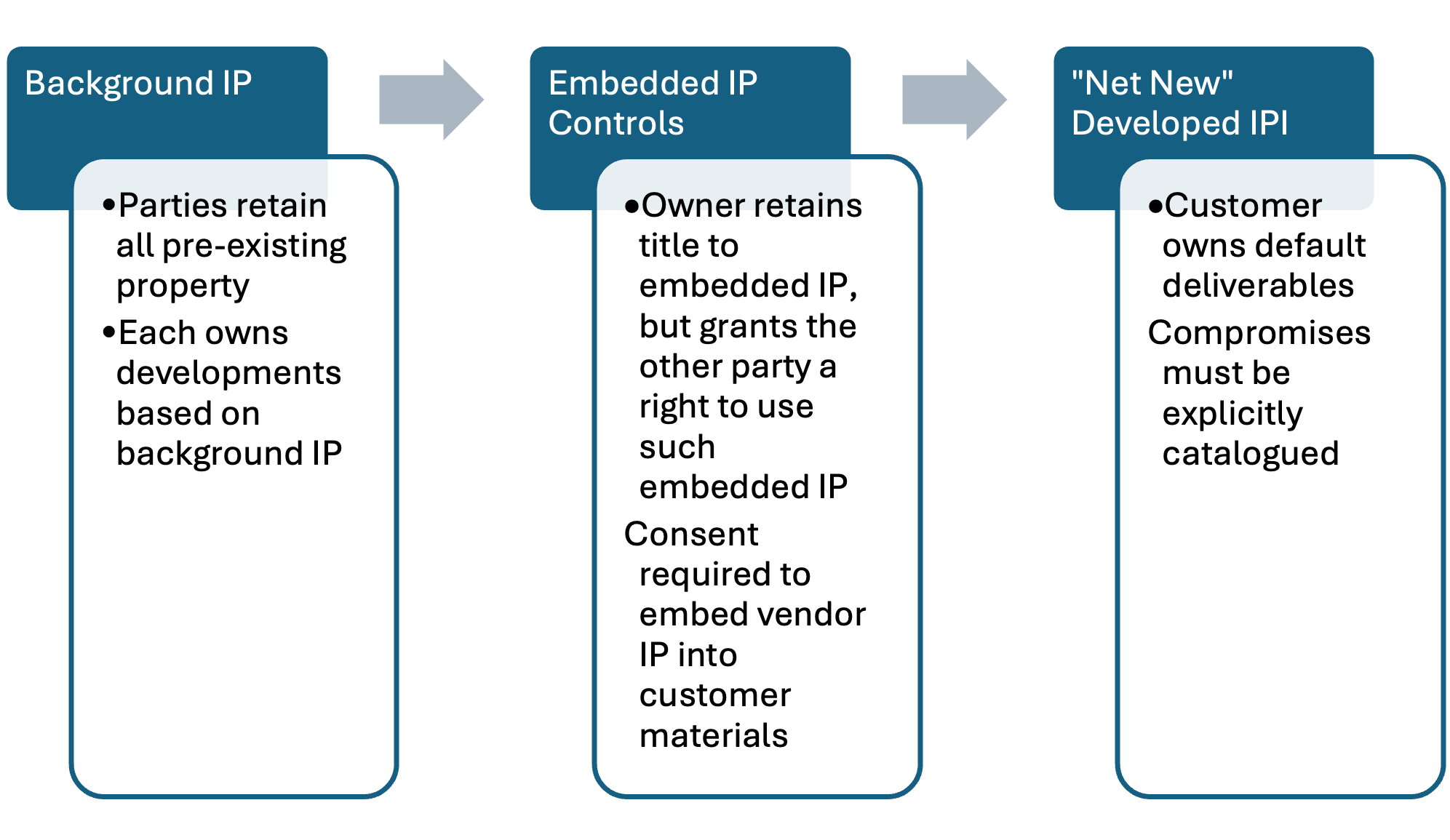
The Intellectual Property Matrix
Transactional lawyers should consider framing the allocation structure around four primary pillars:
1. Preservation of Background IP: The contract should explicitly state that each party retains sole ownership of its pre-existing intellectual property (Background IP). Furthermore, any subsequent modifications or enhancements developed during the term that are directly based on a party's Background IP will continue to be owned by that respective party.
2. Reciprocal Operational Licensing: To ensure uninterrupted performance, each party should grant the other a non-exclusive, worldwide, royalty-free license to use its IP during the term. This license must be contractually limited strictly to the extent necessary to perform the respective party's obligations under the agreement.
3. Embedded IP Restrictions and Consent Guardrails: If a party’s owned IP is integrated or embedded within the other party's materials, the original owner continues to retain full title to that underlying asset. However, the owner must grant a perpetual, irrevocable, fully paid-up license to use the embedded IP for as long as it remains integrated within those materials. Crucially, the vendor must be contractually prohibited from embedding any vendor-owned or third-party IP into customer-owned materials without first notifying the customer and obtaining formal, written consent.
4. Allocation of Newly Developed Materials: Sourcing teams should consider pushing for a default rule stating that other materials developed under the contract—whether created solely by the vendor, solely by the customer, or collaboratively—are owned exclusively by the customer. While commercial compromises can be made on a case-by-case basis, the contract should explicitly specify which materials are being developed and document exactly who will own or license each deliverable.
Conclusion
Specifying the precise boundaries of intellectual property ownership and licensing is critical to preserving corporate assets and preventing costly post-termination disputes. By implementing a clear baseline that protects Background IP while establishing a customer-first default for newly developed deliverables, sourcing teams can prevent vendors from leveraging custom code to create artificial lock-in. Furthermore, reinforcing these provisions with strict notification and consent rules for embedded materials ensures that the enterprise maintains complete visibility and control over its digital architecture throughout the contract lifecycle.
Contact Our Team
This briefing is provided by Palantir Advisors, a global business and legal consulting practice. If you have questions about this briefing, or if you would like to discuss how these issues may impact your business operations, please reach out to us here.